How Does the Royal Filtermist Work?


The principle of impaction can be easily understood by considering a car passing through a fog bank. As the fog hits the windshield, tiny mist particles begin to grow into water droplets which are then shed off.
The Royal Filtermist uses the principle of centrifugal impaction to eliminate mist. With only three main components: a drum, a motor, and the housing, its operation is quite simple.
- A three-phase motor rotates the internal drum at high speed, creating a vacuum which draws mist particles into the center of the drum.
- The mist particles then collide with the rotating drum’s vanes and are forced together with other particles, causing them to coalesce and form larger, droplet-sized particles.
- As the particles grow into droplets, they pass through the perforations in the rotating drum and centrifugal force causes them to be thrown onto the inner wall of the housing.
- The particles are then forced, under pressure, up the walls of the housing to the oil return channel, where they are subsequently drained back to the machine’s coolant tank.
Note – it is important to understand that the pads that line the Filtermist drum are not filters. These porous pads are present to slow airflow through the unit, thereby maximizing contact with the drum vanes for greatest overall impaction efficiency.
- Clean, oil-free air blows past the motor and is returned to the shop.
- Since this process relies on the mechanical principle of centrifugal impaction and the rotational speed remains constant, the Royal Filtermist maintains a continuous high efficiency.
- For certain applications that produce smoke and/or very fine mist particles, an after filter may be required. This filter easily mounts to the top of the Filtermist unit by slipping over the motor and it is secured in place with two toggle clips. An after filter mounted to a Royal Filtermist typically enjoys a comparably long service life because most contaminants are removed by the impaction process prior to reaching the filter.
Royal Filtermist FX Series Design Features
The Royal Filtermist FX Series is the ninth generation of Filtermist. FX Models incorporate a number of design improvements over previous versions to provide the most advanced and effective system available for the removal of mist and smoke.

- Compact design and reduced weight provide greater mounting flexibility.
- Oil return channel has been enlarged, enabling unit to process a greater volume of liquid.
- Gap between drum and housing has been optimized for maximum filtration efficiency.
- Conical air deflector positioned at intake accurately controls airflow within unit.
- Energy-efficient IE3 three-phase motor meets all federal, state, and local electrical and safety codes.
- Exceptional vibration control through dynamic balancing, uniform mass distribution, and neoprene isolators separating the motor/drum assembly from the housing.
- Curved drum vanes improve airflow.
- Air flow is automatically regulated as machine doors close to keep the correct negative pressure inside the enclosure. No need to adjust drum speed.
Royal Cyclonic Swarf Separator

- Recommended for applications that generate solid particles, such as wet grinding dust, cast iron fines, etc.
- Also good for high-speed aluminum milling that produces light fly-away chips.
- Cyclonic action removes solid particles, ensuring that only mist is drawn into the Filtermist unit.
- Acts as a great pre-filter for high pressure coolant applications.
- Reduces maintenance in difficult applications such as heavy grinding.
- Easily attaches to the bottom of the Filtermist unit. Note – the separator cannot be used in direct-mount applications.
- 6″ diameter intake port is located on the side of the unit.
- 5ft. of return hose is included for continuous draining.
- Two-piece design allows for easy cleaning.
- Not for use in purely dry applications.
- For models FX-900 and FX-1200 only.
- Reduces throughput of Filtermist unit by approximately 300 cfm.
Not Sure Which Model You Need?
Sizing Units
The Royal Filtermist is available in four sizes, based on throughput capacities: 300, 575, 900, and 1200 cfm. Royal Products maintains a database with specifications for many different machine tools, and we recommend you contact one of our applications engineers for your specific sizing requirements. For those who would like a general rule of thumb, we recommend using the following formula to obtain a rough idea of your requirements:
Filtermist Size = Internal Enclosure Volume x 5
For example, suppose you have a small CNC lathe with an internal work envelope measuring 5ft. wide x 3ft. deep x 4ft. high. Multiplying 5x3x4, we see that the machine has an enclosure volume of 60 cu. ft. Multiplying 60×5 we see that 300 cfm is required, so we’d choose the model FX-300.
Although this rule is very simple, it is handy for determining the general size requirements.
If you are not sure which unit to use, please contact your local Royal Filtermist Distributor or one of our applications engineers.
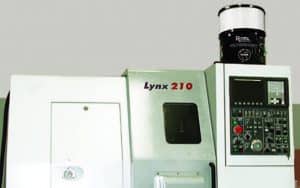
Grinding
Grinding applications can sometimes be more demanding than typical turning and milling applications because grinding produces fine dust particles that become entrained in the mist stream. Over time, this dust can accumulate on the drum pads, resulting in the need for more frequent maintenance. If regular maintenance is not performed and a significant volume of solid matter builds up in the drum, balance and vibration issues may arise.
A simple way to overcome the problems associated with grinding dust is to fit the Filtermist with a cyclonic swarf separator. The separator mounts below the Filtermist unit and uses cyclonic action to separate out the solid matter, leaving the drum free to process the mist and preventing buildup on the pads. A port on the bottom of the unit facilitates drainage.
Royal Products recommends using a cyclonic swarf separator for all grinding applications.
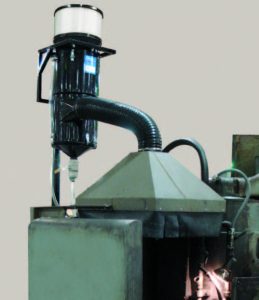
Turning
CNC lathes are relatively easy applications to tackle because the machines are usually well enclosed and direct mounting is often possible. On any well enclosed machine, it is recommended that the Filtermist intake point be located as far from the machining action as possible so that the mist is drawn from an area of heavy concentration to an area of lighter concentration. On CNC lathes, therefore, the ideal intake location is on the right side of the machine, near the tailstock. On subspindle lathes where the right-hand wall moves along the z-axis, it might be necessary for the Filtermist to have a more central location.
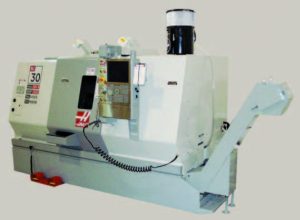
Milling
For enclosed machining centers, the Filtermist intake position should be located in an upper corner of the enclosure. Installation on open-top machines is not as clear-cut. If enclosing the machine is not possible, a successful installation can often be accomplished by suspending the Filtermist unit above the machine and running ducting down into the enclosure. It may be necessary to adjust the intake location so that it is close enough to the spindle to collect the mist, yet far enough away to keep chips from being drawn in. A Y-junction may be used to draw mist from both sides of the spindle, and a chip deflector may also come in handy.
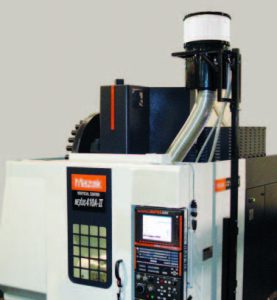
High-Pressure Coolant/Oil
More and more machine tools today are equipped with high-pressure coolant systems. Machines running either oil or coolant at high-pressure tend to create a greater volume of mist, with a smaller average particle size. For high-pressure applications, equipping your Filtermist unit with one (or both) of the performance accessories below will greatly help to optimize mist control within your shop.

High-Performance After Filter
This after filter has been specifically engineered for high-pressure coolant and oil applications. Laboratory and field performance tests have shown the service life to be as great as 10x that of a standard after filter.
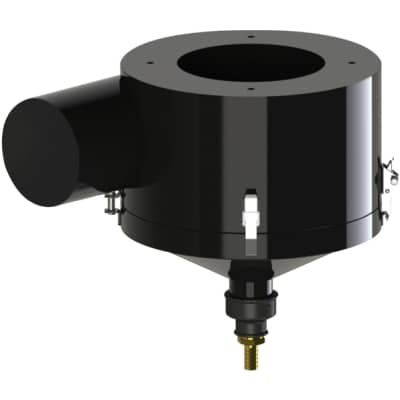
Cyclonic Swarf Separator
While this accessory was originally designed to remove solid particulate entrained in the mist steam, it has also proven to be very effective as a pre-filter in high-pressure applications by removing much of the mist prior to the impaction process.
Risk-Free Performance Guarantee 
Royal’s exclusive Risk-Free Performance Guarantee enables customers to try a Quick-Grip™ or Filtermist on the toughest jobs in their shop for 45-days, and if they are not 100% satisfied with the performance, Royal will take it back and arrange for a full refund.
The following conditions apply:
- The unit must be sized and installed appropriately for the particular machine and application. Contact us to verify the correct unit for your application.
- Credit will be issued for the unit, but may not be issued for ductwork, oil return hoses, etc., if they are not in resalable condition.
- The customer must contact Royal Products for a return material number (RMA #). This number must appear on all paperwork and packaging of the unit being returned.
- The returned unit must be securely packaged and arrive at Royal Products in good condition.
Safety

- Reduced Health Risks
Any form of pollution is potentially dangerous to the lungs, larynx, and skin. - Reduced Accident Risks
Oil mist creates slippery surfaces which increase accident rates. - Reduced Fire Hazards
Oil deposits create a serious fire risk by allowing fires to spread quickly.

Cost
Savings
- Coolant Cost Savings
The Royal Filtermist recycles coolant and returns it to your machine rather than venting it to the atmosphere.
- Heating and Cooling Cost Savings
The Royal Filtermist returns clean air to the shop instead of exhausting it outdoors.
- Cleaning and Maintenance Cost Savings
Uncontrolled airborne mist and smoke deposits result in more frequent cleaning of exposed surfaces.

Increased
Productivity
- Thermal Stability
Filtermist aids in temperature control which can help machines hold tighter tolerances over long-running jobs and/or during unmanned production. - Improved Employee Attendance
A contaminated shop environment often results in higher worker absenteeism and lower morale. - Less Machine Downtime
Fouled contacts in electronic equipment cause expensive downtime. - Higher Speeds and Feeds
Machining operations can run at higher speeds and feeds without the negative effects of increased mist and smoke production. - Better Lighting
Haze from mist and smoke and grimy buildup on shop lighting fixtures cause even the most well-lit shops to take on a dingy appearance. Bright, cheerful environments improve employee morale and performance.

Legal
Issues
- Fewer Workmen’s Compensation Claims
The increase in workmen’s compensation rates from one large claim can cost more than an air cleaning system for an entire factory. - Government Regulations
The current OSHA and NIOSH limits on airborne oil mist are 5 mg/cubic meter, and this requirement is expected to become even stricter in the future. The Royal Filtermist exceeds both the current and new proposed limits.

Attracting Employees
- Attracting and Keeping Good Employees
Your employees expect and deserve a workplace that is as hazard-free as you can make it. One customer, when asked why he wanted to control the oil mist and smoke in his plant, responded, “I wouldn’t expect my office people to work with smoke pouring out of their computers, and I sure don’t expect my shop workers to work on machines with oil mist pouring out of them!”The greatest challenge facing today’s manufacturers is attracting and keeping talented employees. Don’t risk losing good people to the competition because of poor air quality in your shop. Call Royal today!
In order to fully understand why the Royal Filtermist is the best choice for handling oil mist and smoke produced by the metalworking industry, it is important to have some general knowledge of how other types of collection systems work. This section contains an overview of the most common methods for controlling mist and smoke. While these systems all have some positive features, their drawbacks make them unsuitable for use in most metalworking applications.
At one time, the only method for controlling oil mist and smoke in a shop was to vent it out of the building. This was done either by opening the doors and windows or installing a ventilation system. While this method may look like an attractive low-cost solution, the potential dangers should be enough to make any shop owner reconsider this practice.

Environmental Hazards Today, it is illegal in many states to exhaust pollutants to the atmosphere. Offending companies run the risk of large fines and lawsuits.
Fire Hazards Over time, oil deposits collect in the ductwork of ventilation systems, making them prime targets for flash fires and providing pathways for fires to spread quickly.
Cleanliness Problems As mist and smoke travels through a shop to the exhaust points, it collects on exposed surfaces. Over time, a grimy buildup occurs on machines, lights, floors, and walls, resulting in dirty, unsafe conditions.
Media-type filtration systems typically consist of a blower and several filters of varying efficiencies. The contaminated air first passes through a coarse pre-filter where the largest particles are filtered out. It then moves through one or two medium-range filters before reaching the final filter, which is usually made from a high-efficiency HEPA material. Media-type systems are good at collecting dry contaminants such as welding smoke and graphite dust. However, they are often not suitable for metalworking applications where coolant mist is the primary contaminant.

High Operating Costs The biggest drawback of media-type filtration systems is the high operating cost associated with replacement filters. These filters are designed to retain contaminants, so they will become clogged with use. Usually they are made from media that cannot be cleaned, so the only alternative is replacement. Depending upon the cost of the filters and the replacement frequency, this type of system can be quite expensive to operate over the long term.
Decreased Throughput Another problem with multi-stage filter units is that the throughput of the system, measured in cfm, decreases as contaminants become trapped in the pores of the filters. It is important to maintain the correct throughput of any collection system. Reduced throughput means reduced collection, allowing contaminants to escape into the shop air.
Not for Mist Most media filters are designed to collect dry pollutants such as smoke and dust. Exposure to coolant and oil mist may damage certain types of filter media.
Electrostatic precipitators use a blower to draw mist and smoke particles past an ionizer, which imparts a positive charge to them. They then pass across a series of alternately like-charged and grounded collection plates. The particles are repelled by the like-charged plates and forced towards the grounded plates where they collect. The filtered air is returned to the shop.

Variable Efficiency Although electrostatic systems are very efficient when the collection plates are clean, the efficiency drops off drastically as the plates become covered with particles. Each time a particle deposits on a plate, it eliminates a spot for other particles to adhere to.
Maintenance Costs To maintain high efficiency, the collection plates must be cleaned often. This can be expensive because the residue is considered to be hazardous waste and must be disposed of by a certified waste handling company. Many electrostatic systems are sold with costly maintenance contracts, resulting in operating costs that greatly exceed the original unit purchase price.
Health Hazards As the collection plates become full, a phenomenon known as arcing can occur. This arcing results in the production of ozone, which has been found to cause a variety of health problems. This potential danger (and the fear of lawsuits) has caused many U.S. companies to remove electrostatic units from their factories.
The Dangers of Ozone
Ozone produced by electrostatic precipitators has been identified as a health risk to humans. Several U.S. government agencies have weighed-in on ozone as it relates to indoor air quality:
According to the Environmental Protection Agency (EPA): When inhaled, ozone can damage the lungs. Relatively low amounts can cause chest pain, coughing, shortness of breath and throat irritation. Ozone may also worsen chronic respiratory diseases such as asthma and compromise the ability of the body to fight respiratory infections. People vary widely in their susceptibility to ozone. Healthy people, as well as those with respiratory difficulty, can experience breathing problems when exposed to ozone.
Current U.S. guidelines on indoor ozone levels:
- The Occupational Safety and Health Administration (OSHA) requires that workers not be exposed to an average concentration of more than 0.10 ppm (parts per million) for 8 hours.
- The National Institute of Occupational Safety and Health (NIOSH) recommends an upper limit of 0.10 ppm, not to be exceeded at any time.
- Heavy-duty 3-phase motors that meet all federal, state and local electrical and safety codes.
- All exposed surfaces on the drum and housing are powder coated for wear resistance and long life.
- Very tight manufacturing tolerances provide precise fits between mating parts and ensure that the unit will provide years of trouble-free service.
- All drums are dynamically balanced at the factory and tested before shipping.
- Vertical drum arrangement provides even mass distribution.
- Motor is connected to housing with four neoprene mounts, effectively isolating vibration and controlling startup torque.
Royal Standard After Filter

After filters are available for all Royal Filtermist models. They can be used in any application where extreme high efficiency is required, and are especially useful for dealing with the following conditions:
- Applications where heavy, dry smoke is generated along with the mist.
- Applications that produce very fine mist particles which may sometimes bypass the impaction process, (jobs that run at very high spindle speeds, high-pressure coolant, etc.).
Important – An after filter should not be used to compensate for blow-thru that could result from improper installation. If you have questions or concerns about your installation, please contact us.
Standard After Filter Advantages
Easy Installation
The Royal standard after filter simply slides over the Filtermist motor and is secured in place with two toggle clips.
High Efficiency
Adding a standard after filter to a Royal Filtermist unit will greatly increase efficiency in the sub-micron range.
Noise Reduction
An after filter reduces the noise level of a Filtermist unit by approximately 3 dB.
Long Life
Royal standard after filters have extended service lives due to their large surface area. They also last longer because the centrifugal impaction process of the Filtermist removes most of the pollutants before they ever reach the filter. Systems that rely entirely on media filters for the filtering process tend to have much shorter service lives.
Full Range
Standard after filters are available for all size Filtermist units. Models are also available for older series units.
Royal High-Performance After Filters
For very demanding applications, Royal now offers an optimized high-performance after filter.
- Great for all high-pressure oil applications – especially on Swiss machines.
- Unique design incorporates two distinct types of filter media separated by an expansion gap.
- Integral venturi-assisted drain draws liquid away from the filter, greatly lengthening service life – testing has resulted in more than a 10x increase for certain applications.
- Available for all Royal Filtermist FX-series units.
- In stock for immediate delivery.

Royal Cyclonic Swarf Separator
- Recommended for applications that generate solid particles, such as wet grinding dust, cast iron fines, etc.
- Also good for high-speed aluminum milling that produces light fly-away chips.
- Cyclonic action removes solid particles, ensuring that only mist is drawn into the Filtermist unit.
- Acts as a great pre-filter for high pressure coolant applications.
- Reduces maintenance in difficult applications such as heavy grinding.
- Easily attaches to the bottom of the Filtermist unit. Note – the separator cannot be used in direct-mount applications.
- 6″ diameter intake port is located on the side of the unit.
- 5ft. of return hose is included for continuous draining.
- Two-piece design allows for easy cleaning.
- Not for use in purely dry applications.
- For models FX-900 and FX-1200 only.
- Reduces throughput of Filtermist unit by approximately 300 cfm.
Royal Chip Deflector
- Protects the Filtermist intake from chips and direct coolant splash.
- Opening is large enough to ensure that airflow and intake velocity are not negatively affected.
- Powder coated finish protects against rust.
- Can be used with all size Filtermist models.
| MODEL | A | B | C |
|---|---|---|---|
| 30220 (FX-900 & 1200) | 6″ | 9 1⁄2″ | 10″ |
| 30222 (FX-300 & 575) | 4 3⁄4″ | 8 1⁄2″ | 8 1⁄2″ |

A wide variety of mounting options makes the Royal Filtermist very easy to install on virtually any machine tool.
All brackets, stands, and mounting accessories may be ordered individually for your particular application, or you can enjoy the ease of single part number ordering with our universal Easy-Mount™ packages.
For all mounting questions, please contact one of our applications engineers at 1-800-645-4174.
| FX-300 | FX-575 | FX-900 | FX-1200 | |
|---|---|---|---|---|
| Floor Stand | YES | YES | YES | YES |
| Machine Top Stand | YES | YES | YES | YES |
| Wall Mount | YES | YES | YES | YES |
| Side Mount | YES | YES | NO | NO |
| Plenum | YES | YES | YES | YES |
Floor Stand

Useful for open-top machine tools such as vertical machining centers where there is no option for mounting the mist collector on top of the machine.
The floor stand for models FX-900 and 1200 is adjustable from 6-9ft.
The floor stand for models FX-300 and 575 is fixed at 6ft.
Note – all floor stands must be bolted to the factory floor to prevent tipping.
- Filtermist Unit
- Ducting
- Ducting Clamps
- Floor Stand
- Flange Adapter

Wall Bracket

Wall mount brackets are available for all models. These brackets can be mounted to walls or I-beams, and can also be used to mount the mist collector to the side of the machine tool as shown.
- Filtermist Unit
- Ducting
- Ducting Clamps
- Wall Mount Bracket
- Flange Adapter

Machine Top Stand

A great option when you want the mist collector off the floor, but your machine doesn’t lend itself to direct mounting because the ideal intake location within the machine enclosure is not compatible with the mist collector positioning.
The machine top stand for models FX-900 and 1200 has a fixed height of 36″.
Two height options are available for models FX-300 and 575: 28″ and 10.5″.
- Filtermist Unit
- Ducting
- Ducting Clamps
- Machine Top Stand
- Flange Adapter

Side Mount Bracket

The side mount bracket is specifically designed for models FX-300 and 575. It mounts directly to the side of the machine tool with no ducting required.
Bracket includes an integral chip deflector. Provides a very clean installation on most smaller CNC machine tools.
- Filtermist Unit
- Side Mount Bracket

Plenum

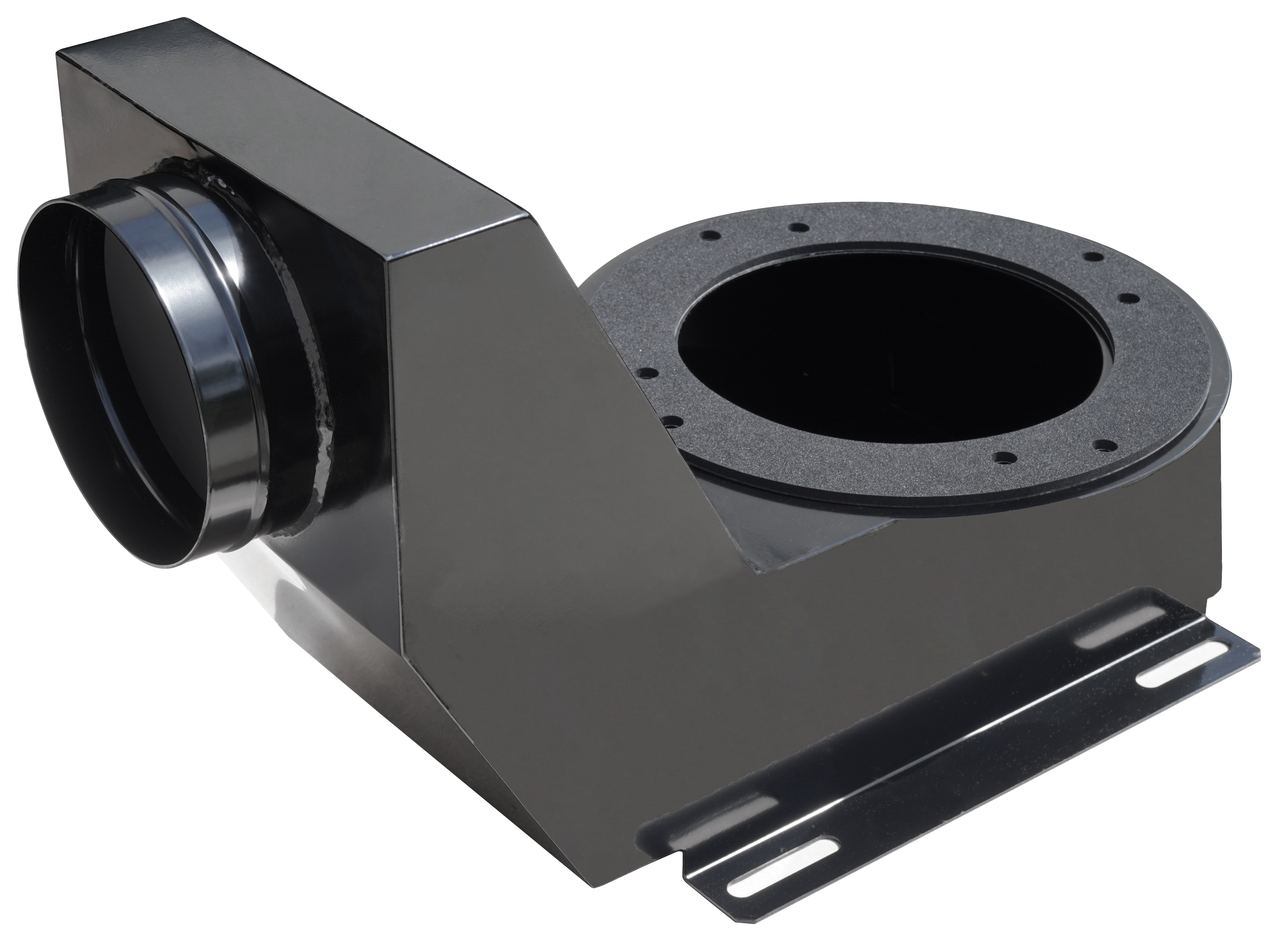
With its side-located intake, Royal’s new plenum offers the flexibility for machine top mounting in applications where the mist collector location and intake point are not compatible. Available for all models.
- Filtermist Unit
- Flange Adapter
- Ducting
- Ducting Clamps
- Plenum
Intake Position — Very Important

No matter what type of machine you are installing your Royal Filtermist on, it is very important to always locate the intake in a position where it will collect mist – not splash. A common mistake is to locate the collection point too close to the cutting action, causing raw coolant and chips to be drawn into the unit.
Whenever possible, draw the mist across the machine enclosure from an area of heavy concentration to an area of lighter concentration. For machines where the intake must be positioned near the cutting action, a deflector can be used to protect the intake from chips and coolant while allowing the mist to pass around it for collection.
The Royal Filtermist is available in four sizes, based on throughput capacities: 300, 575, 900, and 1200 cfm. Royal Products maintains a database with specifications for many different machine tools, and we recommend you contact one of our applications engineers for your specific sizing requirements.
For those who would like a general rule of thumb, we recommend using the following formula to obtain a rough idea of your requirements:
Filtermist Size = Internal Enclosure Volume x 5
For example, suppose you have a small CNC lathe with an internal work envelope measuring 5ft. wide x 3ft. deep x 4ft. high. Multiplying 5x3x4, we see that the machine has an enclosure volume of 60 cu. ft. Multiplying 60×5 we see that 300 cfm is required, so we’d choose the model FX-300.
Although this rule is very simple, it is handy for determining the general size requirements.
If you are not sure which unit to use, please contact us to arrange for a visit from one of our local factory trained representatives or to speak with one of our applications engineers about your specific application.
Grinding applications can sometimes be more demanding than typical turning and milling applications because grinding produces fine dust particles that become entrained in the mist stream. Over time, this dust can accumulate on the drum pads, resulting in the need for more frequent maintenance. If regular maintenance is not performed and a significant volume of solid matter builds up in the drum, balance and vibration issues may arise.
A simple way to overcome the problems associated with grinding dust is to fit the Filtermist with a cyclonic swarf separator. The separator mounts below the Filtermist unit and uses cyclonic action to separate out the solid matter, leaving the drum free to process the mist and preventing buildup on the pads. A port on the bottom of the unit facilitates drainage.
Royal Products recommends using a cyclonic swarf separator for all grinding applications.
For enclosed machining centers, the Filtermist intake position should be located in an upper corner of the enclosure. Installation on open-top machines is not as clear-cut. If enclosing the machine is not possible, a successful installation can often be accomplished by mounting the Filtermist unit above the machine and running ducting down into the enclosure. It may be necessary to adjust the intake location so that it is close enough to the spindle to collect the mist, yet far enough away to keep chips from being drawn in. A Y-junction may be used to draw mist from both sides of the spindle, and a chip deflector may also come in handy.
More and more machine tools today are equipped with high-pressure coolant systems. Machines running either oil or coolant at high-pressure tend to create a greater volume of mist, with a smaller average particle size. For high-pressure applications, equipping your Filtermist unit with one (or both) of the performance accessories below will greatly help to optimize mist control within your shop.
High-Performance After Filter
This after filter has been specifically engineered for high-pressure coolant and oil applications. Laboratory and field performance tests have shown the service life to be as great as 10x that of a standard after filter.
Cyclonic Swarf Separator
While this accessory was originally designed to remove solid particulate entrained in the mist steam, it has also proven to be very effective as a pre-filter in high-pressure applications by removing much of the mist prior to the impaction process.
If you have any questions regarding the use of these performance accessories in your high-pressure applications, please contact us to schedule a visit by one of our factory-trained mist control experts.
When evaluating the effectiveness of any mist collection system, two major aspects must be considered:
- The unit must be capable of handling the full volume of mist produced by the application.
- The unit must be efficient at capturing particles of all sizes.
Independent testing has proven the Royal Filtermist FX Series to be very effective at handling large volumes of mist and highly efficient at dealing with the full spectrum of particle sizes found in typical metalworking mist concentrations.
While a typical metalworking mist concentration is made up of many different-sized particles, usually 80 – 90% of these particles are larger than one micron in size, and fewer than 10% of the particles are smaller than 0.5 micron in size.
In order to effectively eliminate mist, the Royal Filtermist incorporates a two-phase process:
-
- The first phase utilizes the mechanical process of centrifugal impaction. This centrifugal impaction process is the heart of the Filtermist’s operating principle and it is highly effective at handling large volumes of mist.The centrifugal impaction process is almost 100% efficient at handling particles larger than one micron, which tend to make up the bulk of the mist. When considering a weighted average of the particle size in a typical metalworking mist concentration, overall efficiency of the impaction process is roughly 98%.
- Many may consider an efficiency of 98% to be adequate for their needs. However, if additional efficiency is required, the Royal Filtermist FX Series units may be equipped with an after filter to handle the small amount of residual mist that bypasses the impaction process. Royal after filters use a carefully selected grade of media that provides an effective balance between being fine enough to capture the smallest of particles while still allowing the filter to enjoy a comparatively long service life. Overall efficiency of a Royal Filtermist FX Series unit equipped with an after filter exceeds 99.5%.
OSHA and NIOSH Standards
The OSHA and NIOSH limits on airborne mist particles are currently set at 5 mg / m3. It is believed that in the coming years this level will be reduced by a factor of ten to a new level of 0.5 mg / m3. The Royal Filtermist FX is so efficient that when equipped with an after filter, it easily meets not only the current limit, but even the stricter proposed limit.
| LOCATION | CONCENTRATION (mg / m3) |
|---|---|
| Ambient Shop Air | 0.75 |
| FX-1200 Inlet | 8.0 – 10.0 |
| FX-1200 Exhaust | 0.18 |
Basic sizing information can be found above in “Choosing the Right Filtermist Unit”. You are always welcome to speak to one of our engineers if you have any questions. We can also arrange to have one of our local regional managers visit your factory to check out your application and make the appropriate recommendations.

The Royal Filtermist is a relatively easy piece of equipment to install, and most shops handle their own installations. Detailed instructions are included with each unit.
To ensure a smooth installation process, be sure you have ordered all of the necessary mounting and performance accessories. Please note that all accessories offered in this catalog have been tested for performance and safety. Substituting accessories with non-Royal items could void the Filtermist warranty, affect performance, and result in dangerous operating conditions.
 The three-phase Filtermist motor must be wired in conjunction with a motor starter switch, which can be purchased through Royal Products. We suggest you have a licensed electrician perform the wiring of the unit. Detailed instructions can be found in the installation manual that is supplied with each unit.

An important aspect to understand about the Royal Filtermist is that the drum pads are not filters. These porous pads are present to slow airflow through the unit, thereby maximizing contact with the drum vanes for greatest overall impaction efficiency.
Because the Royal Filtermist utilizes the mechanical process of centrifugal impaction to eliminate mist, maintenance requirements are minimal. As a result, some customers have reported that they have had units operating for up to five years without ever needing to change the drum pads.
